Real time data means more time at the face.


Real time data means more time at the face.

Vent Tech Shortage Spurs Growth, New Offerings

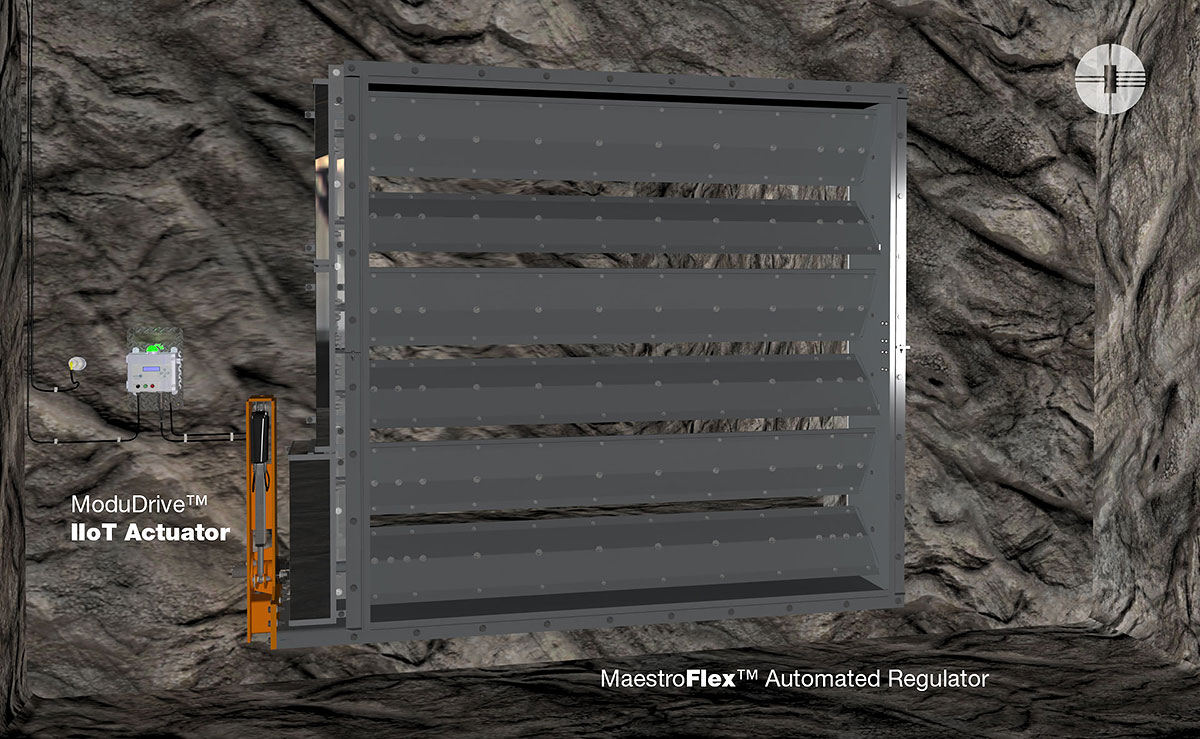
Image of a regulator superimposed on a rock background.

Article by Jesse Morton from Engineering and Mining Journal, October Edition 2023

Making the Complex Simple

Maestro Digital Mine announced the integration of MaestroFlexTM Automated Regulators and ModuDriveTM IIoT Linear Actuators to allow the customer to set air quality sensor value thresholds from the surface. The solution empowers the actuators to dynamically adjust regulators to maintain precise environmental levels, leadership at the supplier said.

“The breakthrough lies in our dynamic edge-based decision capability integrated into the ModuDrive system,” said Jahanzeb Sohail, P.Eng., chief operating officer. The system’s ability to maintain local control independent of the service network, even during downtime, “adds a layer of resilience that the industry has never seen before.”

The solution offers improved safety underground by helping ensure workers are protected from harmful gas exposure. “It doesn’t stop there,” he said. “It also allows the capability to reduce blast clearance times, enhancing productivity and allowing miners to return to work quicker and safer.”

The “pivotal” innovation can be used to “not only safeguards lives but boost efficiency and sustainability in underground mining,” Sohail said. “In 2023, we are paving the way for a safer, more productive and environmentally responsible mining future.”

The development furthers the company’s range of cutting-edge air quality, VOD, and communication solutions for underground mining. For ventilation applications, the supplier offers sensors and systems for continuous air quality monitoring. The sensor and system data “is processed, analyzed, and provides actual insights into operating environments,” Sohail said. “A lot of the mines operate it to proactively address any potential air quality issues, ensuring safety and productivity excellence.”

A Maestro air quality monitoring system is reportedly easy to install, use, maintain, and grow, compared to an in-house system built piecemeal by a miner. It offers lower CapEx and OpEx, Sohail said.

“Our solution reduces CapEx by selling a multivariable device to customers with everything tying into one IP address,” he said. It can offer reduced engineering costs, simplified and streamlined integration, and has low infrastructure requirements.

“For example, your gas sensors, your air flows, differential pressure, and the list goes on,” can all be tied to one IP address, Sohail said.

Maestro air quality system solutions can shorten an installation project schedule by “allowing devices to be scaled and modularized,” which also allows “for the ever-expanding mine operations over time,” he said. “It allows the IoT solutions to basically be scalable, manageable and maintainable, for every factor of the mine, especially operators…”

Read the full article in the International Mining Magazine here.


Continue reading
4518 Hits

Mining’s Ventilation Vanguard: How Asset Managers Influence ESG Integration in Mine Ventilation Strategies

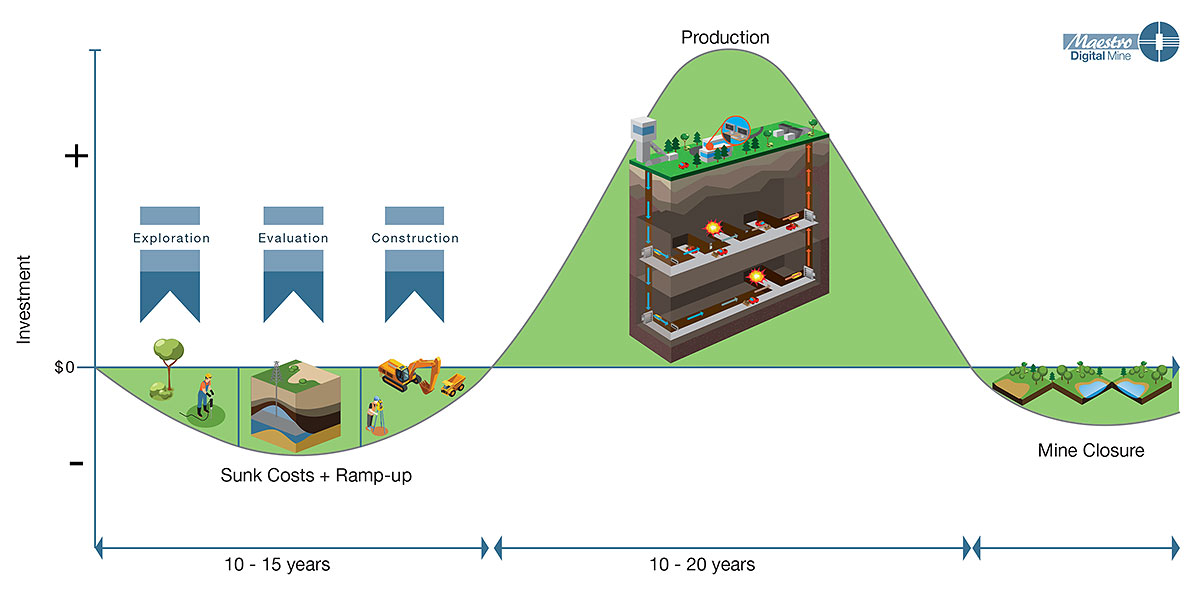
Infographic showing investment in production over time in years

Article by Jacob Lachapelle, CIT at Maestro Digital Mine, for the Canadian Mining Journal, November Edition 2023

There is a transformation taking place in mining, and it is not being driven by regulatory guidelines and public sentiment, but by financial juggernauts that control the purse strings of this industry.

BlackRock is at the frontline of this movement, placing a strong emphasis on ESG (Environmental, Social, and Governance) principles. This shift towards ESG is reshaping the landscape of investment strategies in the mining sector, pushing companies to evolve and adapt to meet these new criteria.

Fink and BlackRock are part of a larger shift in the financial industry that views sustainability as a financial necessity. This shift is clearly visible in the actions of asset managers such as BlackRock and Vanguard who handle trillions of dollars in investment dollars. They are increasingly prioritizing ESG factors by providing guidelines for industries and businesses to adhere to ESG standards.

Confronted with this reality, mining companies find themselves at a crossroads. Given the capital-intensive nature of their operations and their reliance on external funding, mining companies must demonstrate an unwavering commitment to ESG goals to secure the necessary funding.  

The inherently capital-intensive nature of the mining sector makes it particularly vulnerable to shifts in investment criteria. While other industries may have more flexibility to adapt to changing expectations, the significant upfront costs and long project timelines associated with mining mean that companies in this sector must be proactive in aligning their operations with ESG principles.

Examining the differences between the mining sector and traditional industries reveals the unique challenges mining companies face.

Read the PDF version of this article here.

Read the complete article at the CMJ Digital Edition site here (Page 20).


Continue reading
11834 Hits

The Most Dangerous Gas is the One That Goes Undetected

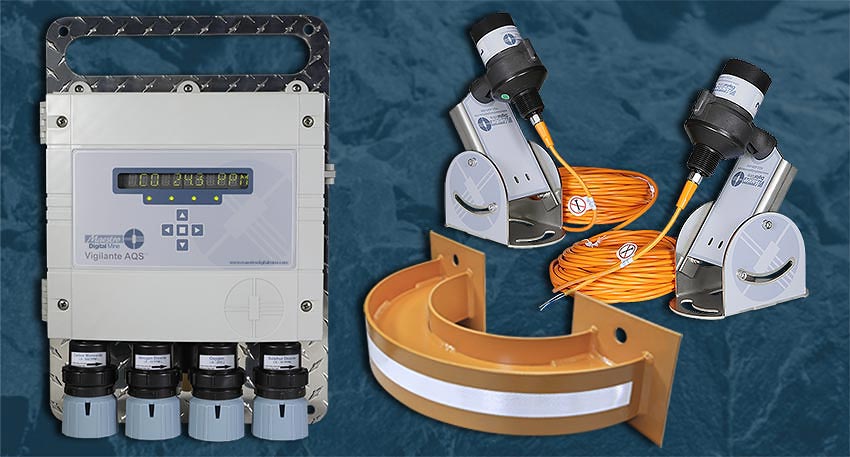
Image of the Vigilante AQS air quality monitoring station components

Three Signs Your Underground Gas Sensors Need Replaced


The most dangerous gas present underground is not carbon dioxide.

It is not nitrogen dioxide or sulfur dioxide.

The most dangerous gas underground is the one that goes undetected.


Undetected methane accumulation was a critical factor in one of the deadliest mining disasters in modern U.S. history. On April 5, 2010, a methane ignition at the Upper Big Branch Mine in West Virginia escalated into a massive coal dust explosion, killing 29 workers. Subsequent investigations found that hazardous gas conditions were not reliably identified in time by required examinations and monitoring systems.

Later that same year, methane explosions at the Pike River Mine in New Zealand claimed the lives of 29 miners. The Royal Commission of Inquiry concluded that failures in gas monitoring systems, sensor reliability, maintenance, and safety management allowed dangerous conditions to persist undetected.
The lesson from these tragedies, and many others involving toxic gas exposure, is not that gas monitoring systems were absent.

It is that the presence of monitors does not guarantee accurate detection.

Gas detection systems are sophisticated electronic devices, and like all such equipment, their sensors degrade over time. Environmental exposure, contamination, vibration, temperature extremes and normal wear are all factors that gradually affect how sensing elements respond.
When that degradation occurs, it rarely announces itself. From the surface, it appears to be functioning as normal. Devices remain powered, readings continue to display, alarms are still enabled and ready to sound. Underground, however, that façade of normalcy can be misleading. The sensor may still be reporting data, but no longer with the accuracy or responsiveness to reflect real conditions. Decisions continue to be made based on that data, even as its reliability declines.

Apart from regular bump testing, recognizing when sensors are no longer performing as intended is critical. Below are three clear signs that gas sensors should be replaced before degraded performance turns into exposure, injury, or worse.

1. Your readings need a reality check

One of the clearest signs a gas sensor needs to be replaced is when its readings are repeatedly unreliable. For instance, in an area where diesel equipment is frequently operated, your sensors should historically show a predictable rise in measured gases. If, over time, the same equipment produces smaller or slower changes in readings than expected, or worse, fails to detect any gas at all, it means the sensor isn’t doing its job. 

2. Calibration becomes a recurring nightmare

Speaking of calibration, another clear sign that a gas sensor may need to be replaced is when calibration stops being a routine task and starts becoming a recurring problem. 
In these cases, calibration can still be completed, but the results rarely stick. A sensor may come back into specification at first, only to drift again a week later.  When calibration starts failing frequently, your sensor is waving a red flag and telling you its core technology is breaking down and continuing to rely on it is a recipe for risk. 

3. It’s seen better days

Mining environments are harsh. Dust, water, vibration and temperature extremes all take their toll, even on the most durable of sensors. Any visible physical damage, from a cracked casing or broken screen to a worn-out button or corroded battery compartment, can compromise the integrity of the sensor itself. If your gas sensor is starting to show its age, it’s time to replace it. 

The events at Upper Big Branch Mine and Pike River Mine are reminders that gas monitoring systems can be present while hazardous conditions still go unrecognized. Reliable detection depends on sensors performing as intended, not simply existing within the system.

Ensuring detection remains dependable includes recognizing when sensors have reached the limits of their effective life and replacing them before accuracy declines.

At Maestro Digital Mine, air quality monitoring is designed to be maintained over time, not installed and forgotten. Sensors within Maestro monitoring stations are intended to be tested, serviced, and replaced as operating conditions and performance change underground.

For support with sensor replacement and air quality monitoring, contact This email address is being protected from spambots. You need JavaScript enabled to view it..


Continue reading
854 Hits

Maestro Digital Mine Introduces PoE-Enabled SuperBrite™ Marquee Display for Underground Mining

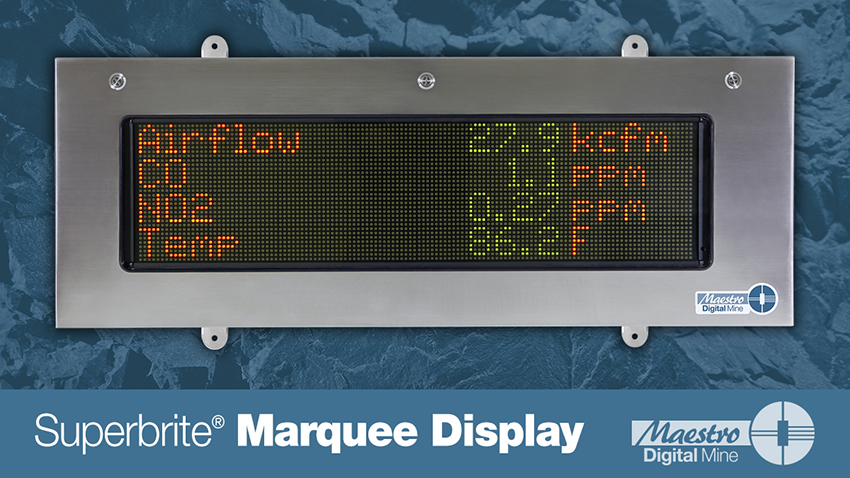
Image of the Superbrite Marquee Display

Single-cable design simplifies underground electrical deployment while improving reliability and content delivery


Sudbury, Ontario
— Extending electrical power underground is one of the most complex, costly, and safety-critical aspects of deploying digital infrastructure in mining environments. Maestro Digital Mine is addressing that challenge with the launch of its Power over Ethernet (PoE)-enabled SuperBrite™ Marquee Display. By delivering power and real-time data over a single Ethernet cable through Maestro’s Plexus PowerNet communications system, the display eliminates the need to run high-voltage AC power to each unit, simplifying installation and reducing electrical risk underground.

In underground operations, installing traditional AC-powered digital signage often requires certified electricians, additional panels and breakers, safety inspections, and production interruptions that increase project scope, cost, and scheduling complexity. PoE significantly lowers that barrier by allowing displays to be powered using low-voltage Ethernet cabling, reducing installation time and safety constraints. Reducing separate power infrastructure also minimizes potential failure points in environments where dust, vibration, and moisture are constant challenges.

“Extending electrical power in underground mining environments introduces cost, risk, and operational disruption,” said Michael Gribbons, Founder, President and CEO of Maestro Digital Mine. “By using Power over Ethernet, the SuperBrite™ Marquee Display removes the need to treat signage as a special electrical project. It becomes a standard, managed network device, delivering trusted information reliably without introducing additional electrical complexity underground.”

Designed for continuous 24/7 operation in harsh underground environments, the SuperBrite™ Marquee Display provides high-visibility LED readouts of real-time environmental and ventilation data, including airflow, gas concentrations, humidity, and temperature. As part of the Maestro Digital Mine ecosystem, the display integrates directly with Vigilante AQS™ and Zephyr AQS™ air quality monitoring stations, delivering live data over a managed PoE network rather than relying on locally maintained systems. Centralized power and network management allow operators to monitor device status, reset displays remotely, and ensure information remains current and visible underground.

Built-in fail-safe behavior alerts crews if communication is lost, preventing outdated information from being relied upon. When powered through PoE switches with backup power, displays can also maintain predictable operation during brief outages, supporting more consistent information delivery in safety-critical environments.

By eliminating the requirement for dedicated electrical infrastructure at each display, the PoE-enabled SuperBrite™ Marquee Display also makes it easier to add, replace, or relocate signage as underground networks expand—without triggering additional electrical work or re-certification.

Maestro Digital Mine will be attending SME MineXchange 2026, taking place February 22–25 in Salt Lake City, Utah. The company will be available to discuss the PoE-enabled SuperBrite™ Marquee Display, along with its broader underground communications and monitoring solutions, at Booth #1126.

About Maestro Digital Mine

Maestro Digital Mine designs and manufactures industrial Internet of Things (IIoT) devices, last-mile digital communication networks and analytics software for underground mining. Its solutions support real-time environmental monitoring, ventilation optimization and digital connectivity, helping mining companies improve worker safety, operational efficiency, and decision-making in complex underground environments.

For more information, visit www.maestrodigitalmine.com.

Media Contact:

Lindsay Moorhouse
Director, Marketing and Communications
Maestro Digital Mine
This email address is being protected from spambots. You need JavaScript enabled to view it.


Continue reading
401 Hits
footer.jpg